
Immersive 3D tours can support sales by strengthening the presentation of a property, hotel or exhibition. Yet the usual entry barriers remain high: specialist capture hardware and ongoing cloud subscriptions deter many estate agents, architects, hotels, museums and agencies. A self-hosted Matterport alternative changes that equation by building spatial experiences from simple 360° photos.
What makes Panomity a Matterport alternative?
Panomity is a Matterport alternative that combines depth maps, which assign depth to image areas, with dense 3D Gaussian splats and floor-plan data in the CMS4VR platform. It creates walkable splats and a Dollhouse overview built from a floor plan and scene positions, without requiring a specialist camera or cloud subscription. The AI stack runs on Panomity’s infrastructure in Germany.
What is Gaussian splatting?
Gaussian splatting is a 3D rendering method that represents a scene with many coloured spatial elements called Gaussians. Together, these elements form a dense scene that a viewer can display from changing perspectives. In practical terms, the method gives image information a spatial form for presentation in a 3D viewer.
A conventional panorama shows a complete view from a fixed camera position. A 3D Gaussian splat represents calculated spatial depth and can be viewed from changing perspectives. This separates navigation between panoramic scenes from movement within a 3D representation.
Panomity creates dense, coloured splats from an equirectangular panorama and a matching depth map. An equirectangular image stores the full 360° view in a flat rectangular format. If you want to understand the source format first, Panomity’s guide to 360-degree images provides useful context.
How does a depth map become a walkable room?
The pipeline first uses DepthAnything V2 on Panomity’s own depth server to generate a depth map for visible image areas. It then combines that map with the panorama’s colours. Spherical projection arranges the image information around the viewpoint and creates a dense 3D Gaussian splat for direct use in the web viewer.
Think of the panorama as a painted sphere around the camera. Every pixel has a direction. The depth map adds an estimated depth value for that direction. Spherical projection can therefore place coloured elements in three-dimensional space rather than leaving them on the surface of a flat image.
Real interiors contain difficult transitions. A doorway can create a sudden jump from a nearby wall to a more distant room. Windows and open sky can produce very large depth values. Panomity’s conversion handles edges at these depth discontinuities and caps far depth for areas such as windows and sky. The conversion applies both steps before it creates the splat.
The finished data uses the antimatter15 .splat format and goes directly to the web viewer. This creates a clear production path: one 360° panorama, one generated depth map and one dense, coloured 3D result. There is no need to send the source image to a US cloud AI service.
Can a single image become 3D in under a second?
Yes. Panomity integrates Apple SHARP, a method for monocular view synthesis that converts a single photo into 3D Gaussian splats in under one second. The integrated job runs on Panomity’s own GPU. The stated speed and method come from the paper “Sharp Monocular View Synthesis in Less Than a Second” (arXiv 2512.10685).
“Monocular” simply means that the process starts with one image rather than a stereo camera pair. For content teams, that opens another route from existing visual material to a spatial presentation. SHARP complements the panorama-and-depth pipeline; both routes produce Gaussian splats while remaining within the same self-hosted processing environment.
The point is not a generic speed claim for every stage of a finished virtual tour. The documented figure applies specifically to SHARP’s single-image-to-3D synthesis. Tour structure, floor-plan preparation and complete reconstruction are separate tasks. Keeping that distinction clear makes the performance statement useful and verifiable.
What does the Dollhouse view add?
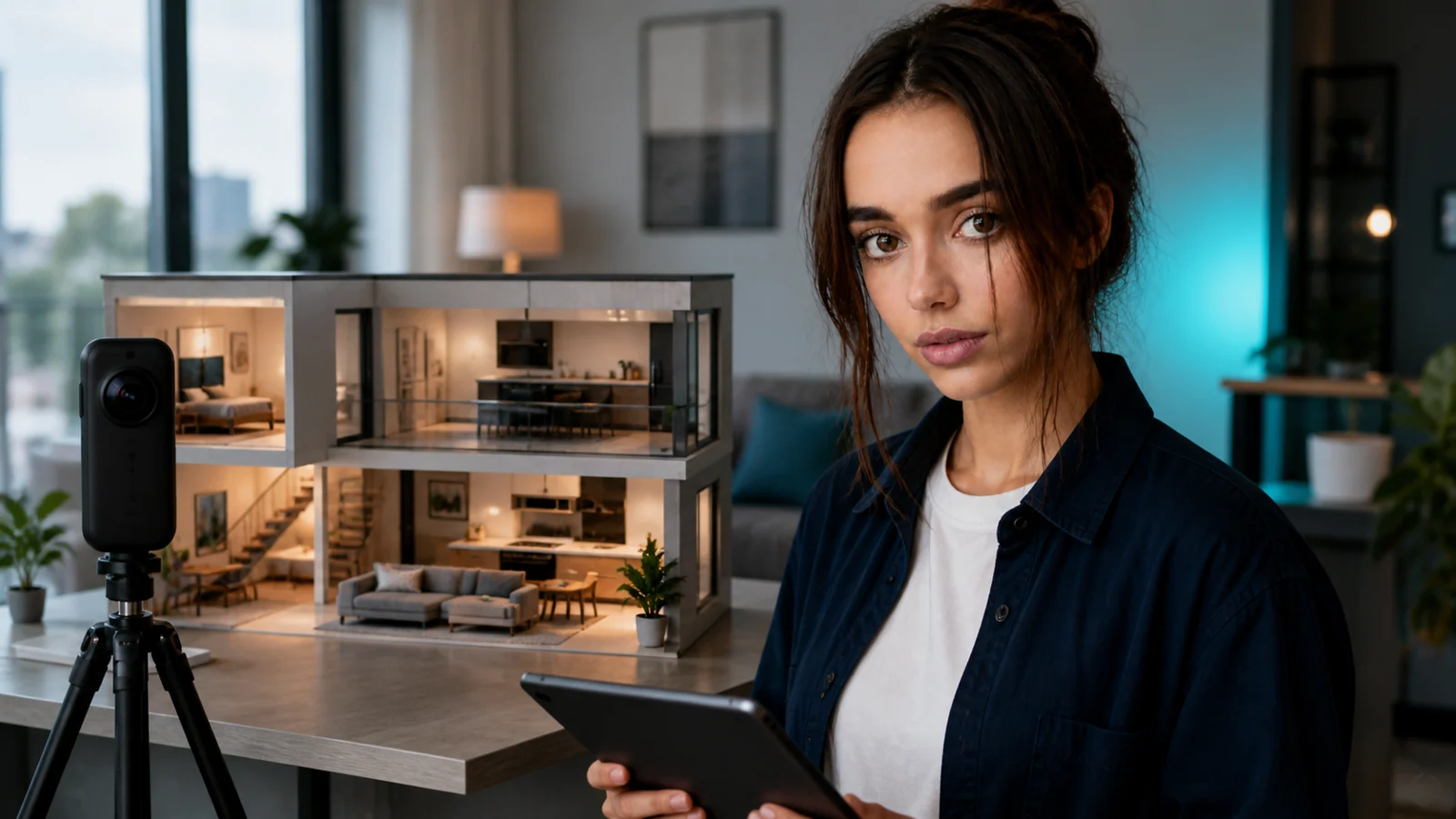
The Dollhouse view presents the tour as a compact spatial overview, similar to looking into an open model building. Panomity builds this navigation from a floor plan and the positions of individual scenes. Visitors can understand the arrangement of rooms before entering them, while multilingual room names support audiences in different languages.
The floor plan supplies the structure, and scene positions anchor the tour within it. Visitors receive a global overview alongside access to individual panoramic viewpoints.
When is full reconstruction the professional option?
For projects that need a complete apartment reconstruction, Panomity provides a full 3D Gaussian Splatting pipeline. This reconstruction workflow combines the software components COLMAP and Nerfstudio with gsplat and runs on the company’s own hardware. It extends the single-view routes with an option for comprehensive spatial reconstruction.
COLMAP and Nerfstudio are components in Panomity’s 3D reconstruction workflow. Within the stack, they form the path for full apartment models rather than the one-panorama conversion. The distinction lets professional teams select an appropriate level of processing for a project.
Panomity also covers the adjacent format of 360-degree videos. The full reconstruction described here remains the self-hosted COLMAP, Nerfstudio and gsplat pipeline for complete apartments.
How does self-hosted GPU processing protect control?
Panomity processes depth, SHARP, vision, chat and speech tasks on its own infrastructure in Germany. It sends no source data to US cloud AI APIs. This self-hosted architecture can support a GDPR-oriented setup and gives operators control over the described data flows while keeping the services behind the virtual tour within one controlled technical environment.
One GPU serves several AI functions, so Panomity coordinates the workload through its own GPUQ job queue. GPUQ shares capacity fairly between chat, vision, speech-to-text, depth estimation and SHARP. Status heartbeats show that jobs remain active, while queue position and estimated time of arrival can be sent to the front ends.

Classic 360° tour or 3D splat tour?
A classic 360° tour and a splat-based experience start from immersive imagery but present space differently. The classic format centres on panoramic scene viewpoints. The 3D route combines colour and estimated depth, while the Dollhouse adds an overview from floor-plan and scene-position data. The right layer depends on the intended presentation.
| Aspect | Classic 360° tour | 3D splat tour with Panomity |
|---|---|---|
| Source material | 360° panoramas | 360° panorama plus generated depth map |
| Presentation | Navigation between panoramas | Dense, coloured 3D Gaussian splat in the web viewer |
| Spatial overview | Individual connected scenes | Dollhouse from floor plan and scene positions |
| Output | Krpano-based CMS4VR tour | antimatter15 .splat format in the web viewer |
| Processing | Krpano-based CMS4VR platform | Self-hosted depth, GPUQ and 3D pipeline |
Both formats belong to the Krpano-based CMS4VR platform. Its 3D pipeline adds splats and Dollhouse orientation to panoramic scene navigation within the same self-hosted environment.
Frequently asked questions
Do I need a specialist camera for Panomity?
No. Panomity creates walkable Gaussian splats from simple 360° photos and provides Dollhouse navigation from a floor plan and scene positions. There is no specialist-camera requirement. The splat pipeline uses an equirectangular panorama and the depth map calculated from it on Panomity’s own server.
What is a depth map?
A depth map assigns spatial depth values to the image areas of a panorama. Panomity’s own depth server generates it with DepthAnything V2. Spherical projection then converts the panorama and depth map into a dense, coloured 3D Gaussian splat for the web viewer.
What is the difference between a Gaussian splat and the Dollhouse view?
A Gaussian splat is the dense, coloured 3D representation generated from image and depth information. The Dollhouse is an overview and navigation layer built from a floor plan and scene positions, with multilingual room names. They therefore serve different tasks for presentation and orientation.
Do the 3D functions run in an external AI cloud?
No. Panomity runs its AI stack entirely on self-hosted infrastructure in Germany and sends no data to US cloud AI services. DepthAnything V2, SHARP and the COLMAP-Nerfstudio pipeline run on its own infrastructure. This keeps the described data flow under the operator’s control; legal compliance still requires review.
Can Panomity also reconstruct complete apartments?
Yes. A full 3D Gaussian Splatting pipeline with COLMAP, Nerfstudio and gsplat is available for complete apartment reconstructions. It runs on Panomity’s own hardware. This route complements the splat from a single 360° panorama and Dollhouse navigation from a floor plan and scene positions.
Conclusion: a Matterport alternative built around your content
Panomity brings depth maps, Gaussian splats, SHARP, Dollhouse navigation and full reconstruction into one self-hosted platform. It gives estate agents, architects, hotels, museums and agencies a direct route from simple 360° photos to Matterport-style 3D experiences, without a specialist-camera requirement or cloud subscription.
Explore how virtual tours can present spaces online, then plan the right combination of panoramic scenes, spatial splats and Dollhouse navigation for your project. With processing on Panomity’s own hardware in Germany, immersive presentation and data control can remain part of the same decision.

0 Comments